ios-statusbar-spacer

To reduce the risk of COPD exacerbations in patients with severe COPD associated with chronic bronchitis and a history of exacerbations
DALIRESP safety profile
DALIRESP is not a bronchodilator and is not indicated for the relief of acute bronchospasm
In 8 controlled COPD studies:
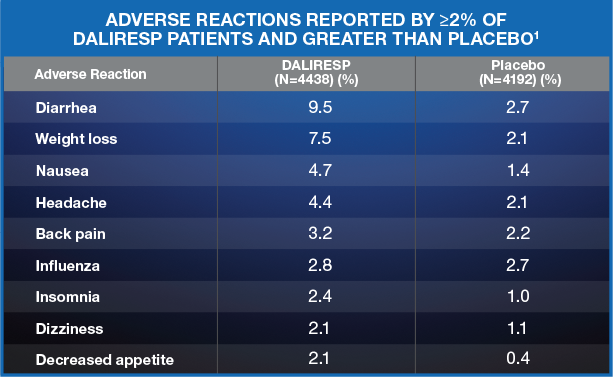
Most common adverse reactions with DALIRESP1
The safety data described below reflect exposure of 4438 patients to DALIRESP 500 mcg once daily in four 1-year placebo-controlled trials, two 6-month placebo-controlled trials, and two 6-month drug add-on trials. In these trials, 3136 and 1232 COPD patients were exposed to DALIRESP 500 mcg daily for 6 months and 1 year, respectively1
In these controlled COPD studies:
Overall rate of discontinuation due to adverse reactions was 14.8% for DALIRESP and 9.9% for placebo1
The safety profile of DALIRESP reported in Trial 9 was consistent with the key pivotal studies.1
Psychiatric Adverse Reactions
Treatment with DALIRESP is associated with an increase in psychiatric adverse reactions. In 8 controlled clinical trials 5.9% of patients treated with DALIRESP 500 mcg reported psychiatric adverse reactions vs 3.3% treated with placebo. The most common psychiatric adverse reactions reported at higher rates in the DALIRESP 500 mcg vs placebo-treated groups were insomnia (2.4% vs 1.0%), anxiety (1.4% vs 0.9%), and depression (1.2% vs 0.9%). Three patients treated with DALIRESP experienced suicide-related adverse reactions (one completed suicide and two suicide attempts) compared to one patient (suicidal ideation) treated with placebo. In an additional placebo-controlled 1-year clinical trial (Trial 9), which assessed the effect of DALIRESP when added to a fixed-dose combination of an inhaled corticosteroid and long-acting beta agonist, one patient completed suicide while receiving DALIRESP
Prescribers should advise patients, their caregivers, and families to be alert for the emergence or worsening of insomnia, anxiety, depression, suicidal thoughts or other mood changes, and if such changes occur, to contact their health care provider. Prescribers should carefully evaluate the risks and benefits of continuing treatment if such events occur. Before using DALIRESP in patients with a history of depression and/or suicidal thoughts or behavior, prescribers should carefully weigh the risks and benefits of treatment with DALIRESP
Weight Loss Adverse Reaction
In addition to weight loss being reported as a common adverse reaction, weight was prospectively assessed in two 1-year clinical trials. In these studies that compared DALIRESP to placebo, 20% vs 7% experienced moderate weight loss (5%-10% of body weight) and 7% vs 2% experienced severe weight loss (>10% body weight). During the follow-up period after discontinuing DALIRESP, the majority of patients regained some of the weight they had lost1
Patients should have their weight monitored regularly. If unexplained or clinically significant weight loss occurs, weight loss should be evaluated and treatment discontinuation should be considered
DALIRESP is not a bronchodilator and should not be used for the relief of acute bronchospasm
To reduce the risk of COPD exacerbations in patients with severe COPD associated with chronic bronchitis and a history of exacerbations
In the two 1-year pivotal studies:
Duration of events was evaluated among all patients who experienced diarrhea (N=203) and nausea (N=103)2
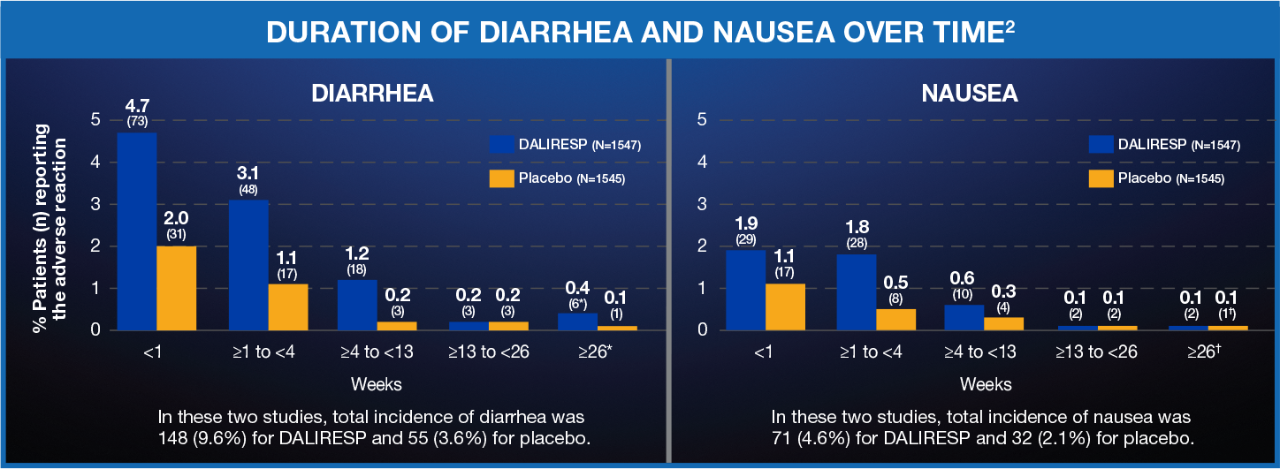
*Includes 1 additional patient in the roflumilast group whose diarrhea was ongoing.
†Includes 1 additional patient in the placebo group whose nausea was ongoing.
In the two 1-year pivotal studies:
Diarrhea and nausea were among the 3 most common adverse reactions reported by patients taking DALIRESP in clinical trials1
For the majority of patients who reported diarrhea and/or nausea, it was mild to moderate and generally lasted less than 4 weeks2
For some patients, diarrhea and nausea persisted beyond 4 weeks. In rare instances, diarrhea was a serious adverse reaction that occurred more frequently with DALIRESP than placebo2
In the 8 controlled COPD studies:
Overall rate of discontinuation due to adverse reactions was 14.8% for DALIRESP and 9.9% for placebo1
Discontinuation rates due to diarrhea and nausea were 2.4% and 1.6%, respectively
DALIRESP is not a bronchodilator and should not be used for the relief of acute bronchospasm
To reduce the risk of COPD exacerbations in patients with severe COPD associated with chronic bronchitis and a history of exacerbations
Drug Interaction Profile
Before prescribing DALIRESP:
It is important to ask your patients if they are taking any concomitant medications before prescribing DALIRESP.
In drug interaction studies:
Drug interaction studies were performed with roflumilast and other drugs likely to be coadministered or drugs commonly used as probes for pharmacokinetic interaction.1
NOT RECOMMENDED1
Strong cytochrome P450 enzyme inducers (including rifampicin, phenobarbital, carbamazepine and phenytoin)
Concomitant use with medications is not recommended as they decrease systemic exposure and may reduce the therapeutic effectiveness of DALIRESP.
USE WITH CAUTION1
CYP3A4 inhibitors and dual inhibitors of CYP1A2 and CYP3A4 (including erythromycin, ketoconazole, fluvoxamine, enoxacin and cimetidine)
Oral contraceptives containing gestodene and ethinyl estradiol
Concomitant use with these medications may increase DALIRESP systemic exposure and may result in increased adverse reactions.
The risk of concurrent use should be weighed carefully against the benefit.
NO SIGNIFICANT INTERACTION1
Salbutamol (albuterol)
Formoterol
Budesonide
Theophylline
Montelukast
Digoxin
Warfarin
Sildenafil
Midazolam
Maalox
DALIRESP is not a bronchodilator and should not be used for the relief of acute bronchospasm
IMPORTANT SAFETY INFORMATION
Contraindications
DALIRESP® (roflumilast) is contraindicated in patients with moderate to severe liver impairment (Child-Pugh B or C).
Warnings and Precautions
DALIRESP is not a bronchodilator and should not be used for the relief of acute bronchospasm
Prescribers should advise patients, their caregivers, and families to be alert for the emergence or worsening of insomnia, anxiety, depression, suicidal thoughts or other mood changes, and if such changes occur, to contact their healthcare provider. Prescribers should carefully evaluate the risks and benefits of continuing treatment if such events occur. Before using DALIRESP in patients with a history of depression and/or suicidal thoughts or behavior, prescribers should carefully weigh the risks and benefits of treatment with DALIRESP
Treatment with DALIRESP is associated with an increase in psychiatric adverse reactions. In 8 controlled clinical trials 5.9% of patients treated with DALIRESP reported psychiatric adverse reactions vs 3.3% treated with placebo. The most common psychiatric adverse reactions in these studies were insomnia (2.4% vs 1.0%), anxiety (1.4% vs 0.9%), and depression (1.2% vs 0.9%). Three patients treated with DALIRESP experienced suicide-related adverse reactions (one completed suicide and two suicide attempts) compared to one patient (suicidal ideation) treated with placebo. In an additional placebo-controlled 1-year clinical trial (Trial 9), which assessed the effect of DALIRESP when added to a fixed-dose combination of an inhaled corticosteroid and long-acting beta agonist, one patient completed suicide while receiving DALIRESP
Patients should have their weight monitored regularly. If unexplained or clinically significant weight loss occurs, weight loss should be evaluated and treatment discontinuation considered
In addition to weight loss being reported as a common adverse reaction (7.5% of patients treated with DALIRESP vs 2.1% placebo), weight was prospectively assessed in two 1-year pivotal clinical trials. In these studies that compared DALIRESP to placebo, 20% vs 7% experienced moderate weight loss (5-10% of body weight) and 7% vs 2% experienced severe weight loss (>10% body weight). During the follow-up period after discontinuing DALIRESP, the majority of patients regained some of the weight they had lost
Use with strong cytochrome P450 enzyme inducers (eg, rifampicin, phenobarbital, carbamazepine, phenytoin) is not recommended, as they decrease the exposure and may reduce the therapeutic effectiveness of DALIRESP
Adverse Reactions
In 8 controlled clinical trials, the most common adverse reactions (≥2% and greater than placebo) were diarrhea (9.5% vs 2.7%), weight loss (7.5% vs 2.1%), nausea (4.7% vs 1.4%), headache (4.4% vs 2.1%), back pain (3.2% vs 2.2%), influenza (2.8% vs 2.7%), insomnia (2.4% vs 1.0%), dizziness (2.1% vs 1.1%), and decreased appetite (2.1% vs 0.4%). The safety profile of DALIRESP in Trial 9 was consistent with the key pivotal studies.
INDICATION AND USAGE
DALIRESP® (roflumilast) is indicated as a treatment to reduce the risk of chronic obstructive pulmonary disease (COPD) exacerbations in patients with severe COPD associated with chronic bronchitis and a history of exacerbations.
Limitations of Use
DALIRESP is not a bronchodilator and is not indicated for the relief of acute bronchospasm
DALIRESP 250 mcg is a starting dose for the first 4 weeks of treatment only and is not the effective (therapeutic) dose
Please read full Prescribing Information, including Medication Guide.
You may report side effects related to AstraZeneca products .
.
References:
Data on File, REF-50379, AZPLP.
Calverley PM, Rabe KF, Goehring UM, Kristiansen S, Fabbri LM, Martinez FJ; M2-124 and M2-125 Study Groups. Roflumilast in symptomatic chronic obstructive pulmonary disease: two randomised clinical trials. Lancet. 2009;374:685-694.
References:
Data on File, REF-50379, AZPLP.
Calverley PM, Rabe KF, Goehring UM, Kristiansen S, Fabbri LM, Martinez FJ; M2-124 and M2-125 Study Groups. Roflumilast in symptomatic chronic obstructive pulmonary disease: two randomised clinical trials. Lancet. 2009;374:685-694.
DALIRESP® (roflumilast) [prescribing information]. Wilmington, DE: AstraZeneca Pharmaceuticals LP; 2020.
Data on File, REF-25736, AZPLP.
Cazzola M, MacNee W, Martinez FJ, et al; American Thoracic Society; European Respiratory Society Task Force on outcomes of COPD. Outcomes for COPD pharmacological trials: from lung function to biomarkers. Eur Respir J. 2008;31:416-469.
Donohue JF. Minimal clinically important differences in COPD lung function. COPD. 2005;2:111-124.
References:
DALIRESP® (roflumilast) [prescribing information]. Wilmington, DE: AstraZeneca Pharmaceuticals LP; 2020.
Watz H, Bagul N, Rabe KF, et al. Use of a 4-week up-titration regimen of roflumilast in patients with severe COPD. Int J Chron Obstruct Pulmon Dis. 2018;13:813-822.
References:
DALIRESP® (roflumilast) [prescribing information]. Wilmington, DE: AstraZeneca Pharmaceuticals LP; 2020.
Data on File, REF-4938, AZPLP.
References:
DALIRESP® (roflumilast) [prescribing information]. Wilmington, DE: AstraZeneca Pharmaceuticals LP; 2020.
Rabe KF. Update on roflumilast, a phosphodiesterase 4 inhibitor for the treatment of chronic obstructive pulmonary disease. Br J Pharmacol. 2011;163:53-67.
Essayan DM. Cyclic nucleotide phosphodiesterases. J Allergy Clin Immunol. 2001;108:671-680.
IMPORTANT SAFETY INFORMATION
Contraindications
DALIRESP® (roflumilast) is contraindicated in patients with moderate to severe liver impairment (Child-Pugh B or C).
Warnings and Precautions
+